8 Inspired Drought-Tolerant Plant Combinations for a Water-Wise Landscape
Drought-tolerant plant combinations don’t have to be dry and boring. Xeriscaping, or designing a landscape that uses as little water as possible, can be achieved while still maintaining a beautiful and interesting landscape. The physical characteristics that allow certain plants to thrive without additional water can also bring fascinating color, texture, and architecture to a design. Choosing plants that are native to regions where water is scarce ensures that you are choosing plants that have naturally evolved to withstand harsh conditions.
To give you some ideas about water, let’s revisit two gardens that feature an inspiring array of drought-tolerant plants. The first is Roger and Mary Greenberg’s garden in Tiburon, California, Texture Extremes. It’s full of clever combinations that thrive in Northern California’s dry summers. While some selections are frost-sensitive, the Greenbergs’ use of exuberant textures and a deftly restrained color palette could be reinterpreted with more hardy plants.
Next, we’ll explore the gravel gardens at Olbrich Botanical Gardens in Madison, Wisconsin, in Digging Deeper Into Gravel Gardens. That article showed you how to build a gravel garden. Now we’ll explore the colorful palette of hardy, low-maintenance plants that give these gardens their signature look. Many of them have a wide range and will work well in gardens all over the country, especially where the soil drains quickly.
Plant Combo 1 (seen above):
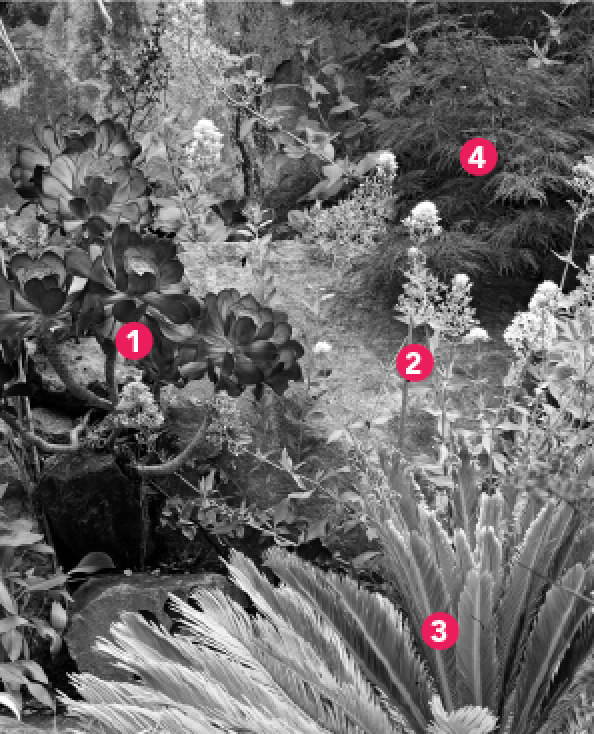 | 1. Aeonium ‘Cyclope’ (Aeonium ‘Cyclops’, Zones 10 to 12) 2. Common valerian (Valerian officinalis*, Zones 4 to 7 3. Sago palm (Cycas revolutaZones 9-10) 4. Japanese maple with threadlike leaves (Acer palmatum var. dissectumZones 5 to 8) |
Succulents, hardy grasses and heat-loving woody plants provide a contrast of form and color in drought-tolerant landscapes
Location: Greenberg Garden, Tiburon, California
A gardener’s eye naturally seeks out interesting patterns and anomalies, and Greenberg’s garden doesn’t disappoint. Standout specimens catch our eye and then share the spotlight with their nearby companions. Repetition of color and form keeps the whole together, and it’s clear that the scale and architecture of the plants have been carefully considered. When creating your own water combinations, these are ideas worth considering. Try to draw from the full range of plant shapes and colors available, and don’t be afraid to experiment.
Plant Combination 2: Repeat and Contrast Shapes to Create Interest
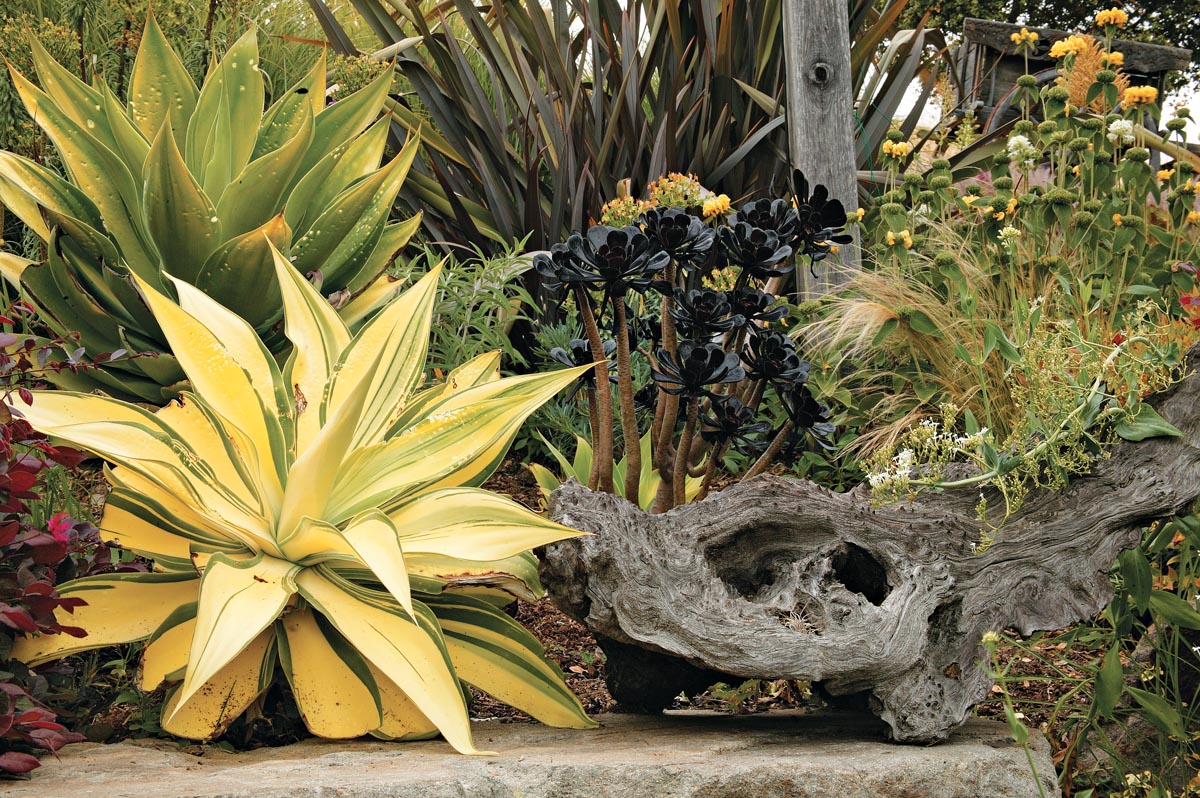
Placing the variegated version of a plant next to the straight species is a great way to use both repetition and contrast for added interest. Here, the brightly colored foxtail agave is the first to catch our eye, and the echo of its greener cousin adds emphasis. Their radiating pattern is echoed by the cordyline, and the mass of the Jerusalem sage helps balance these larger forms.
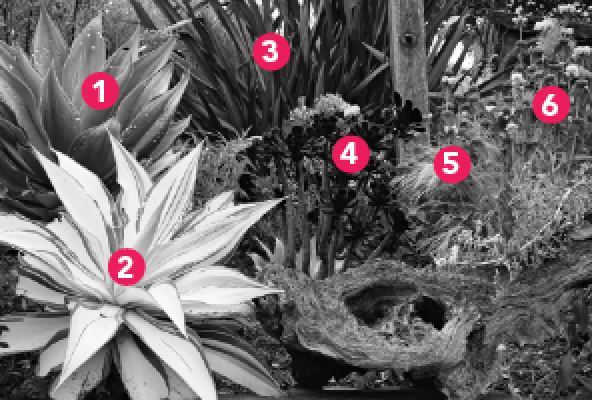
| 1. Foxtail Agave (Agave attenuatedZones 10 to 12) 2. Variegated Foxtail Agave (Agave attenuated ‘Varigata’, zones 10-12) 3. Cordyline (Cordyline australis ‘Atropurpurea’, zones 8 to 10) 4. Aeonium ‘Zwartkop’ (Aeonium “Zwartkop”, zones 9 to 11) 5. Mexican Feather Grass (Nassella tenuissimaZones 7 to 11) 6. Sage of Jerusalem (Phlomis fruticosaZones 8 to 10) |
Plant Combo 3: Take Advantage of the Topography
Planting on a slope allows you to visually stack plants for added impact. Here, ‘Yellow Wave’ phormium spreads broad golden accents across the hillside, and long-flowering Mexican sage provides the perfect complement of color.
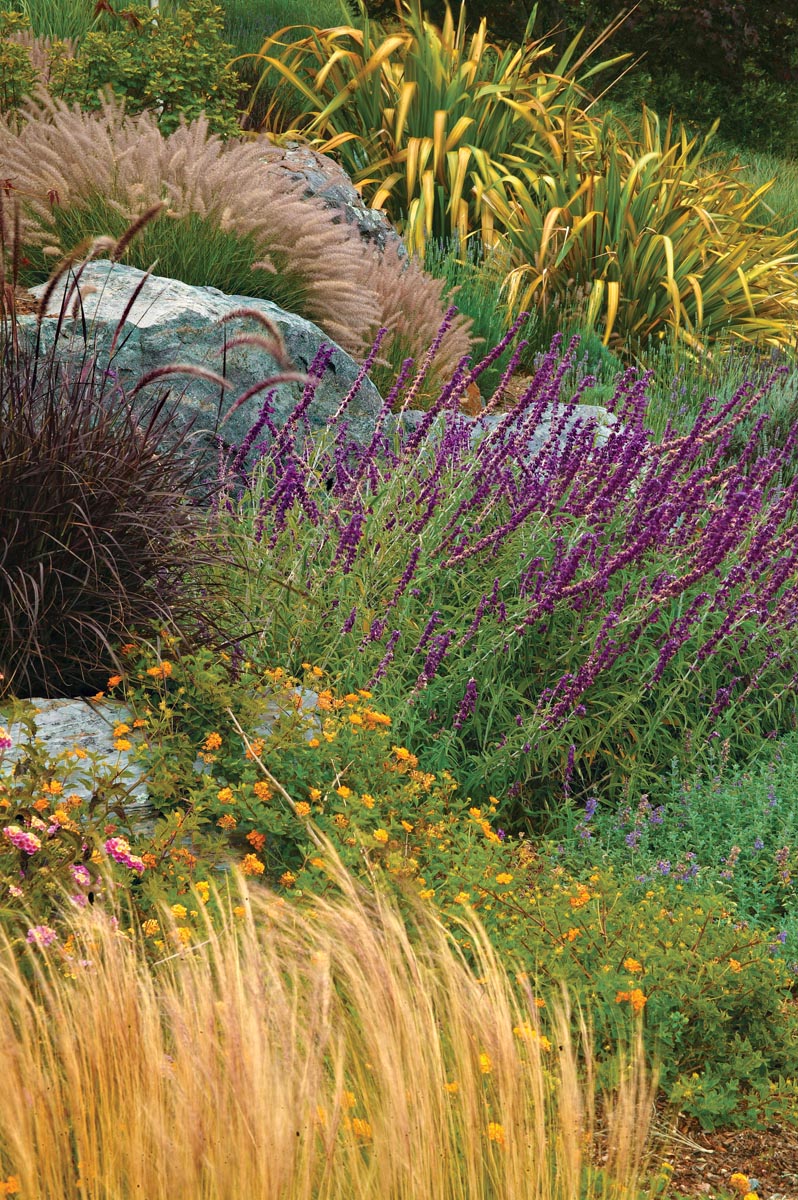
| 1. Oriental fountain grass (Pennisetum orientaleZones 5 to 10) 2. Phormium “Yellow Wave” (Phormium “Yellow Wave”, zones 8 to 11) 3. Mexican bush sage (Sage leucanthaZones 8 to 10) 4. Lantana ‘Gold Mound’ (Lantana camara* “Golden Mound”, areas 10-11) 5. Mexican Feather Grass (Nassella tenuissimaZones 7 to 11) | 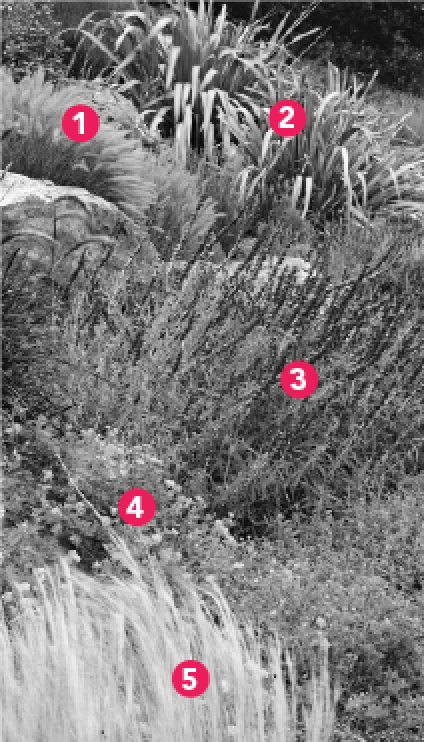 |
Plant Combo 4: Create a subtle blend of soft textures with mass
Wide rows of lavender, bottlebrush grass and feather grass create a perfect, understated backdrop for vibrant cordyline and barberry. Although these cultivars are native to all over the world, the overall effect is reminiscent of a natural plant community.
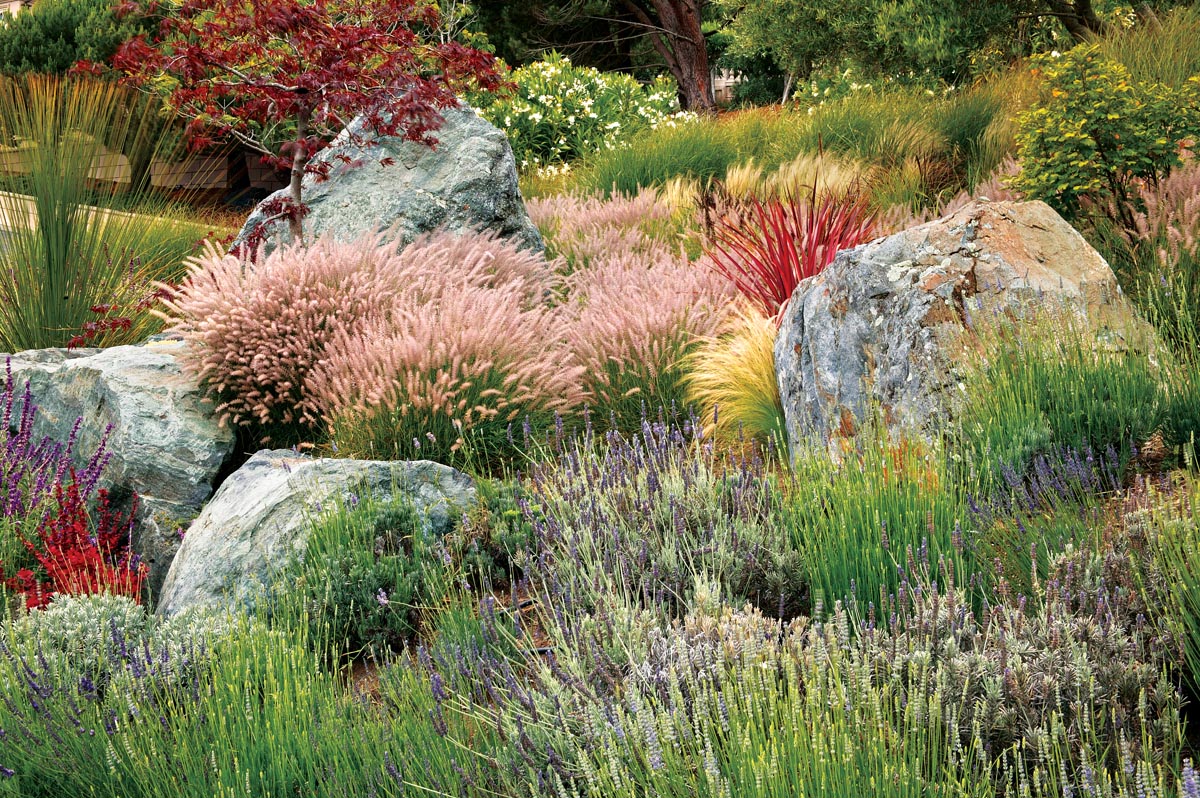
| 1. Mexican grass tree (Dasylirion longissimumZones 8 to 11) 2. Oriental fountain grass (Pennisetum orientaleZones 5 to 10) 3. Festival™ Cordyline burgundy (Cordyline (‘JURred’, zones 8 to 10) 4. Mexican Feather Grass (Nassella tenuissimaZones 7 to 11) 5. Lavender ‘Provence’ (Lavender × intermediate (Provence, Zones 5-9) 6. Barberry ‘Orange Rocket’ (Berberis thunbergii* “Orange Rocket”, zones 4 to 9) | 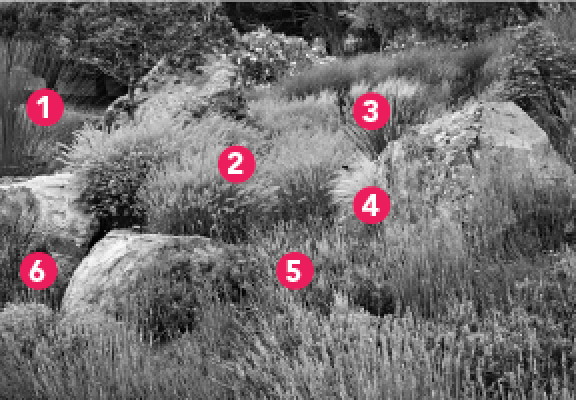 |
Low-water grasses and perennials help create a sense of abundance
Location: Olbrich Botanical Gardens, Madison, Wisconsin
In How to Create a Gravel Garden, author Jeff Epping walked us through the process of building a gravel garden, and readers were treated to some beautiful “after” photos of the inspiring plant combinations that thrive in the gravel beds at Olbrich Botanical Gardens. Here, we see more of the dense plantings that help reduce the need for weeding and ground covers and give these gardens a lush, vibrant feel while conserving water. All of these plants were chosen for their hardiness and low water needs, and many are hardy to Zone 3 or 4.
Plant Combo 5: Add mystery to the garden walk with an overflowing path
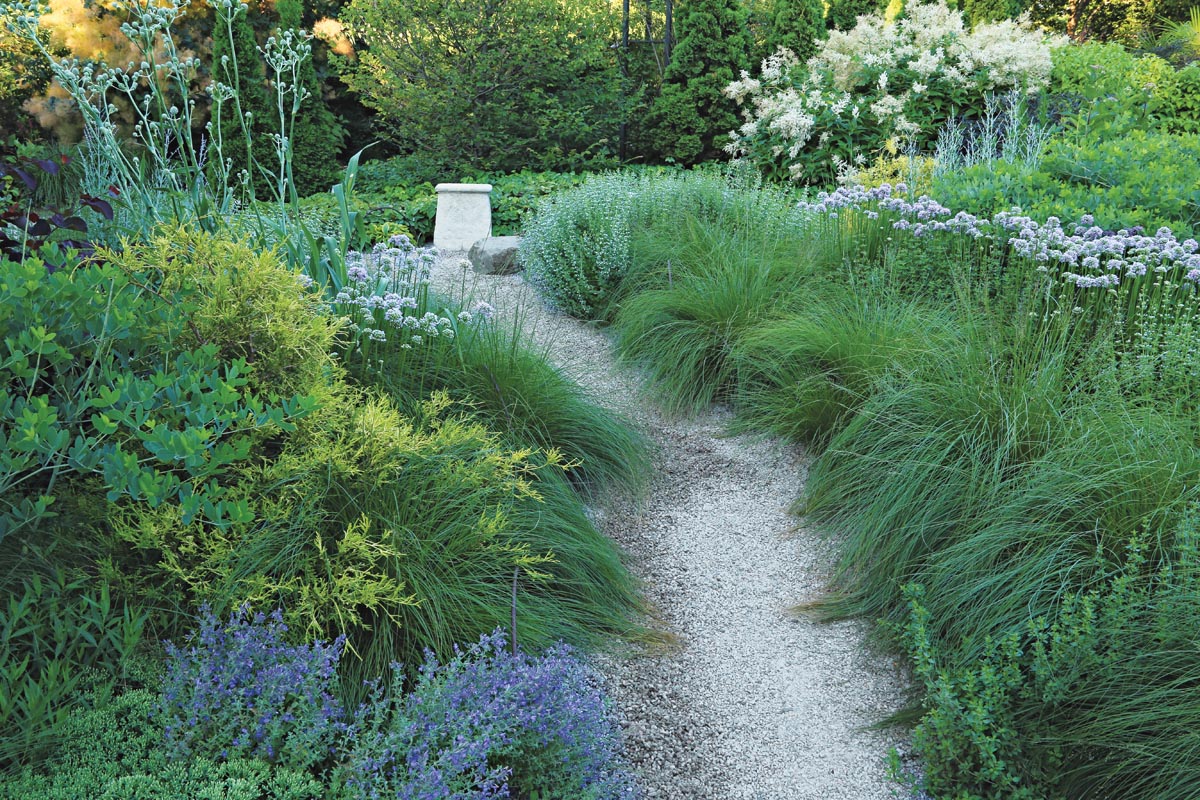
Plant Combo 5: Use a few bold stars to add some sparkle
The giant cotton flower in the background of this photo is a high-impact, low-maintenance perennial that dies back to the ground each year. Here, its shrubby height and volume are on a par with the large drifts of prairie sclerotia and ‘Summer Beauty’ allium. The ‘Golden Mop’ Sawara cypress adds a splash of warm color that blends nicely with the fine-textured plants in the foreground.
| 1. Dwarf catnip ‘Kit Cat’ (Nepeta × faassenii “Kit Cat”, zones 3 to 8) 2. False white indigo (Baptism of the Holy Virgin Mary var. macrophyllasyn. Baptisia leucanthaZones 3 to 9) 3. Sawara Cypress ‘Golden Mop’ (Chamaecyparis pisifera “Golden Mop”, zones 5 to 7) 4. Rattlesnake Master (Eryngium yuccifoliumZones 3 to 8) 5. Allium ‘Summer Beauty’ (Allium angulosum “The Beauty of Summer”, zones 4 to 8) 6. Calamint (Calamintha nepeta ssp. NepetaZones 5 to 7) 7. Meadow vetch (Sporobolus heterolepisZones 3 to 9) 8. Giant Polar Flower (Persicaria polymorphaZones 4 to 9) 9. Russian sage (Perovskia atriplicifoliaZones 5 to 9) | 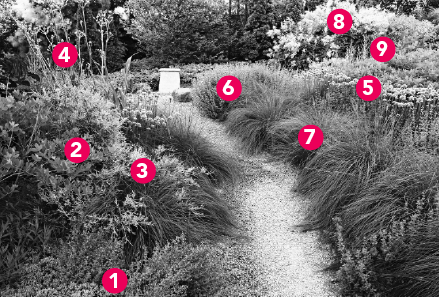 |
Plant Combination 6: Create a cool combination of pale flowers
This combination of plants is impeccable and perfect for weeks. The limited color palette emphasizes the flower form. The delicate petals of the wavy coneflower, which would fade next to brighter blooms, provide a radiant contrast to the clouds of tiny calamint flowers and the abundant umbels of the allium ‘Summer Beauty’. Spikes of Russian sage add height to this grouping, which peaks in mid to late summer.
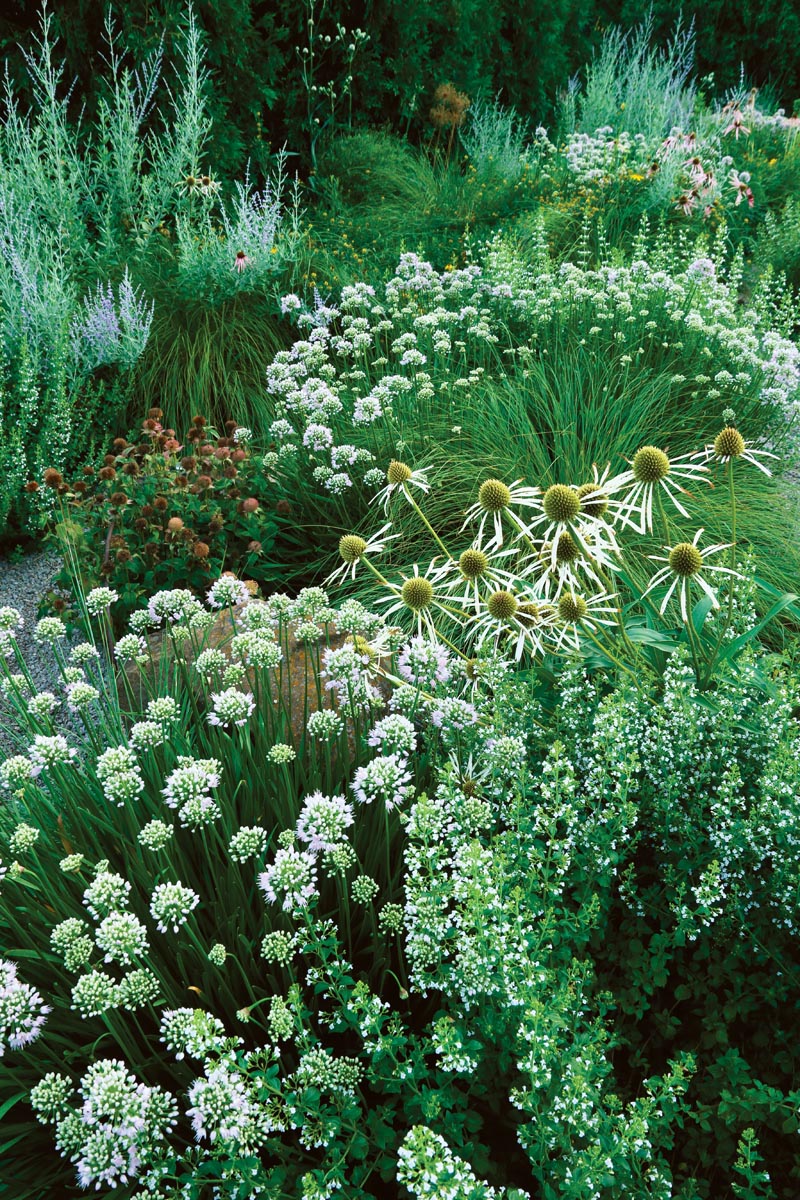
| 1. Calamint (Calamintha nepeta ssp. NepetaZones 5 to 7) 2. Allium ‘Summer Beauty’ (Allium angulosum “The Beauty of Summer”, zones 4 to 8) 3. Wavy-leaved Echinacea (Echinacea simulataZones 5 to 8) 4. Meadow vetch (Sporobolus heterolepisZones 3 to 9) 5. Russian sage (Perovskia atriplicifoliaZones 5 to 9) | 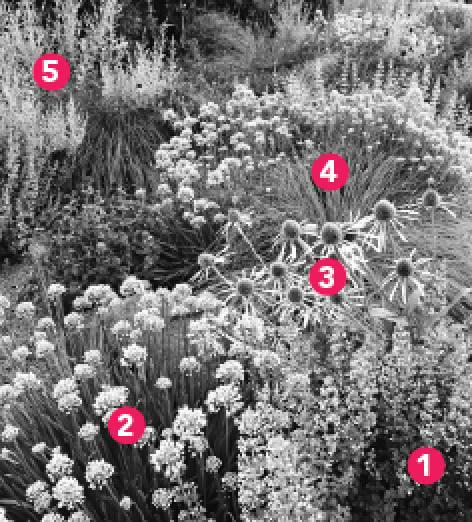 |
Plant Combination 7: Foliage Adds Style
The color here doesn’t just come from the flowers. A dark-leaved penstemon creates interest long after its early summer blooms have given way to clusters of seed pods. Fall flowers, like smooth aster, add a touch of warm chartreuse to the mix as they prepare for their late-season show. Nodding onion is a striking eye-catcher at the front of this border, with its distinctive downward-curving stems.
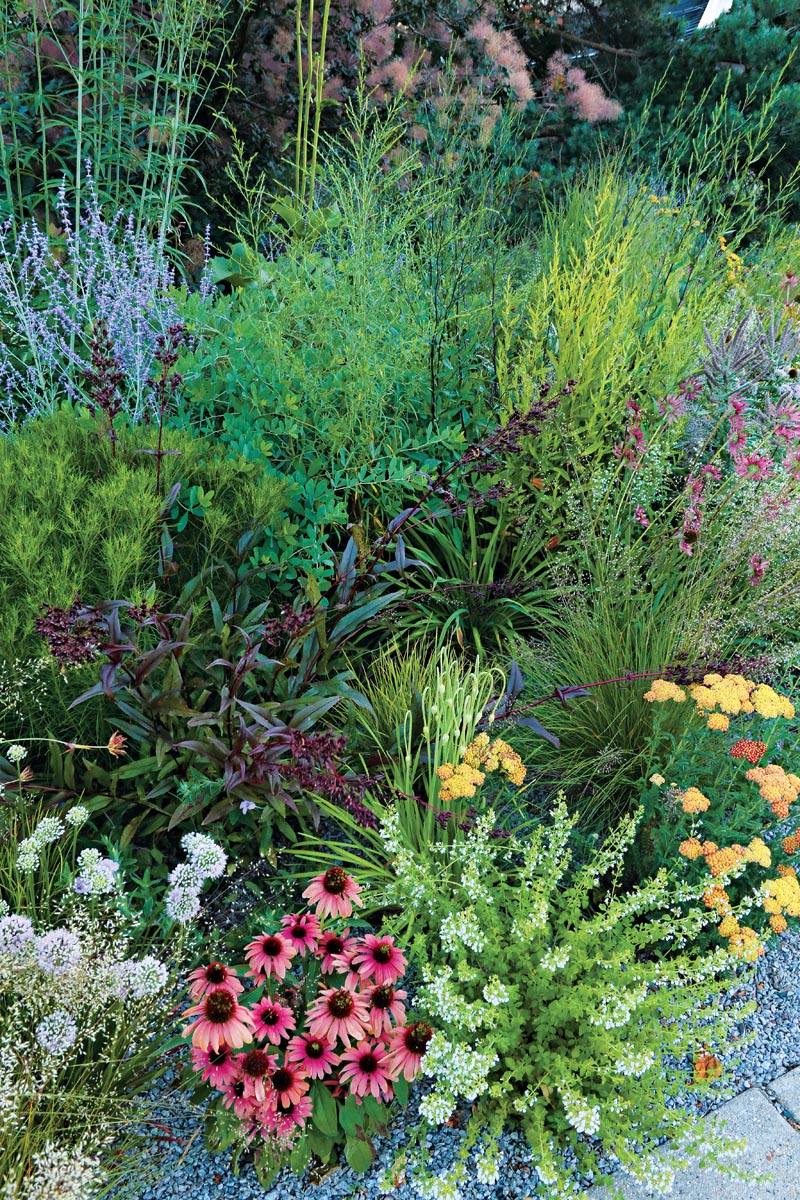
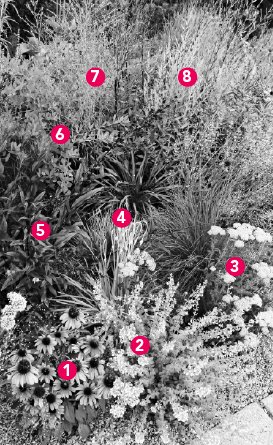 | 1. Echinacea ‘Kim’s Knee High’ (Purple coneflower “Kim’s Knee High”, zones 3 to 8) 2. Calamint (Calamintha nepeta ssp. NepetaZones 5 to 7) 3. Yarrow (Yarrow “Feuerland”, zones 3 to 8 4. Leaning onion (Allium cernuumZones 4 to 8) 5. Penstemon ‘Pocahontas’ (Penstemon digitalis “Pocahontas”, zones 3 to 8) 6. False indigo ‘Lemon Meringue’ (Baptism “Lemon Meringue”, zones 4 to 8) 7. Sky blue aster (Symphyotrichum oolentangienseZones 3 to 8) 8. Smooth Aster (Symphyotrichum laeveZones 3 to 8) |
Plant Combination 8: A contrasting color is noticed first
Graceful, complementary colors draw the eye through this painterly composition. Repeated shapes and colors help tie the bed together. Colors that deviate from the main palette, like the warm salmon of echinacea ‘Kim’s Knee High,’ draw the eye in and keep this collection of plants from feeling too sedate.
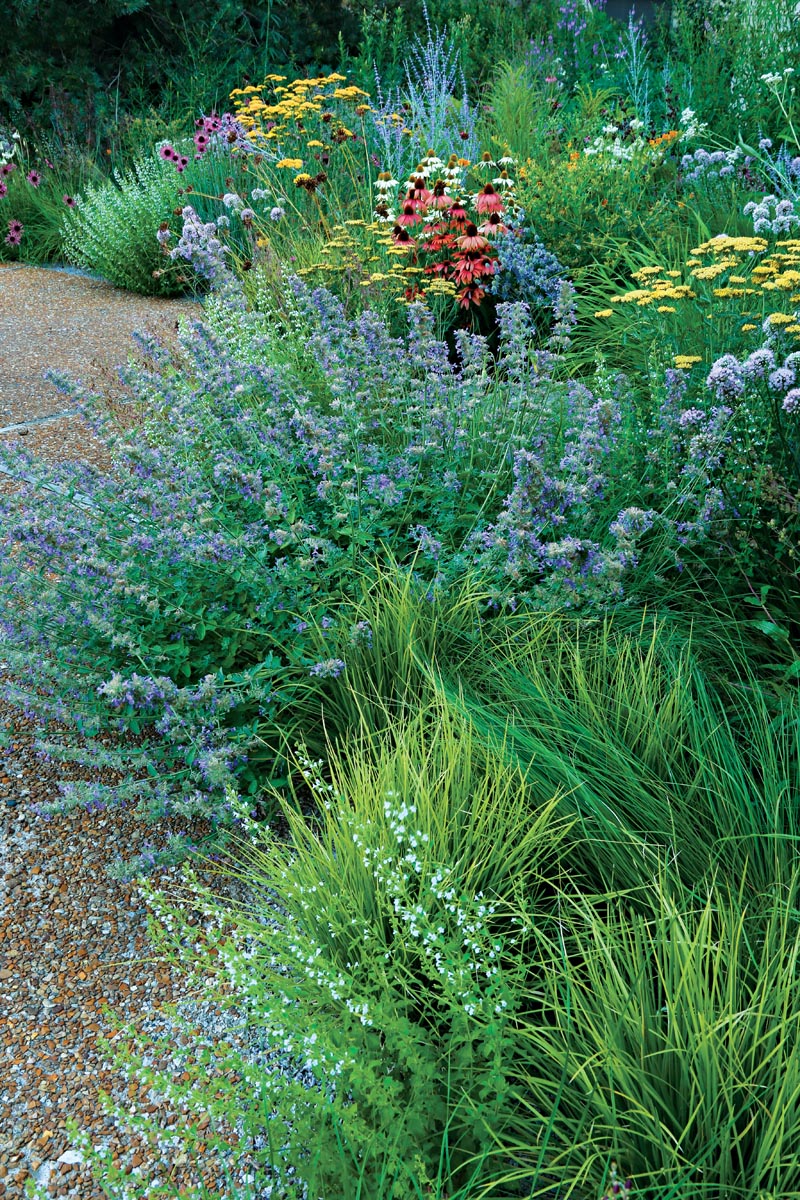
| 1. Autumn moor grass (Autumnal SesleriaZones 5 to 8) 2. Meadow vetch (Sporobolus heterolepisZones 3 to 9) 3. Dwarf catnip ‘Kit Cat’ (Nepeta × faassenii “Kit Cat”, zones 3 to 8) 4. Yarrow (Yarrow “Feuerland”, zones 3 to 8 5. Echinacea ‘Kim’s Knee High’ (Purple coneflower “Kim’s Knee High”, zones 3 to 8) 6. Echinacea ‘Cleopatra’ (Echinacea “Cleopatra”, zones 5 to 8) 7. Russian sage “Little arrow” (Perovskia atriplicifolia “Small arrow”, zones 5 to 9) 8. Calamint (Calamintha nepeta ssp. NepetaZones 5 to 7) 9. Tennessee Echinacea (Echinacea tennesseensisZones 5-6) |  |
BASIC PRINCIPLES
How to spot a water-efficient plant
All plants transpire, releasing water from their leaves to cool themselves. Those adapted to growing in dry locations have physical characteristics that minimize water loss. The following characteristics are common to many water-efficient plants.
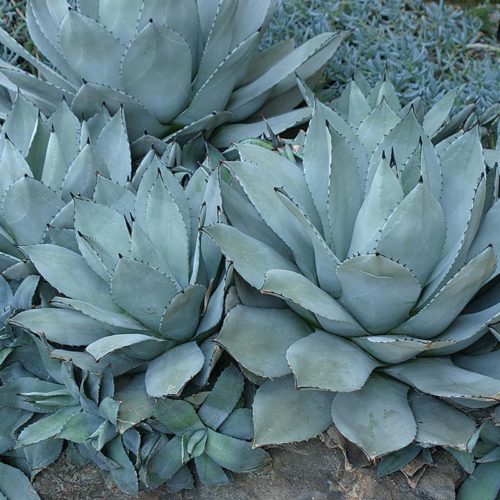
Gray, silver or blue foliage –
Mescal Agave parryi — Zones 7 to 10
Small, thin, herbaceous or dissected leaves —
Uneven seed of the meadows Sporobolus heterolepis, Zones 3 to 9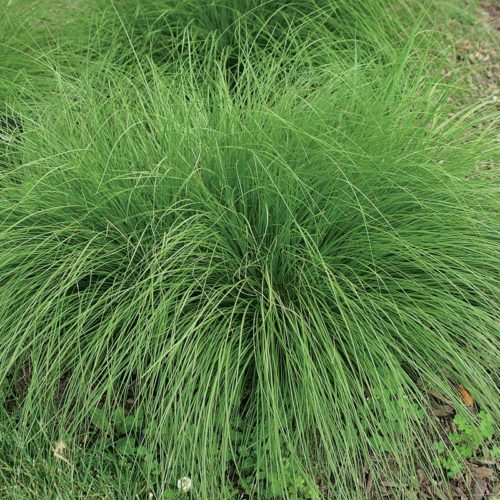
Green stems with thorns or minimal foliage –
Mexican Sea Thistle Eryngium umbelliferum, Zones 7 to 9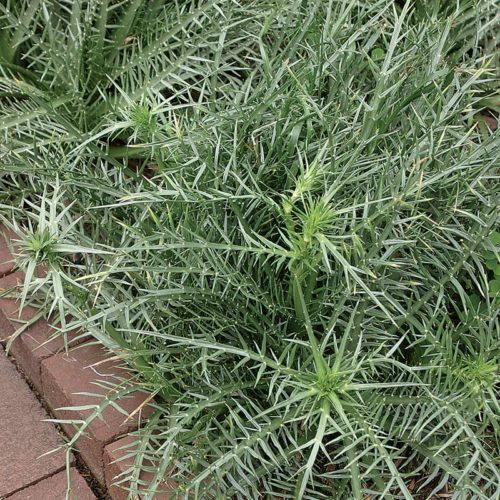
Shiny, waxy leaves –
“Bressingham Ruby” bergenia Bergenia “Bressingham Ruby”, zones 4 to 8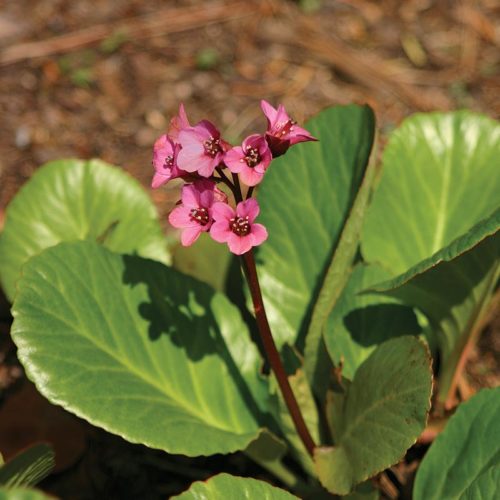
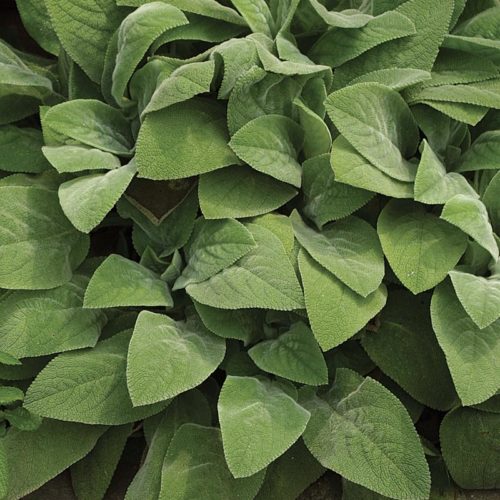
Hairy leaves –
Lamb’s Ear “Big Ears” Stachys byzantina ‘Big Ears’ syn. ‘Helene von Stein’, zones 4 to 9
Carol Collins is editor of Fine Gardening magazine.
2024-07-19 16:17:12
Cacti and Succulents,Dry areas,Fall Interest,Grasses,Spring Interest,Summer Interest,Sun,drought resistant,drought tolerant landscape,Drought Tolerant Plants,dry climate,garden,plants for texture,sago palm
https://www.finegardening.com/article/8-inspired-drought-tolerant-plant-combinations-for-a-water-wise-landscape